Blog
FinOps Explained: How Can Businesses Control Cloud and AI Spend?

Why Does FinOps Matter More Than Ever Today?
Cloud costs are soaring faster than many organizations anticipated. From AI inference and model training to 24/7 microservices, cloud usage has outpaced traditional budgeting.
Most teams overspend not because they are reckless, but because they lack visibility, shared ownership, and a clear connection between engineering decisions and business goals.
The winning organizations will not be those with the lowest cloud spending. They are the ones who tie every dollar to a measurable outcome, ensuring performance and innovation continues without incurring unsustainable expenditure.
This is where FinOps comes into play. FinOps is a cultural and operational system that integrates Finance, Engineering, and Product to control cloud spending. It does not intend to slow engineers down; rather, it enables them to make more informed trade-offs based on real data.
This article explains what’s new in modern FinOps practices, outlines a Five-lever playbook, provides a 90-day roadmap, lists practical KPIs, and concludes with the top five questions any team should consider while starting their FinOps journey
What Has Changed in Modern FinOps?
Standardized Cost Data Through FOCUS Specifications
Industry-wide FOCUS specifications have resulted in a common schema for cloud billing. This helps organizations compare usage and spend across providers and work toward genuine multi-cloud visibility
Improved Visibility for AI and Kubernetes Workloads
Tools like OpenCost allow teams to see how much GPU and container workloads cost. Instead of guessing, teams can allocate spend to a specific product, service, or feature.
Cost Guardrails Integrated into CI/CD Pipelines
More teams are adding cost checks earlier in the delivery cycle so expensive changes are caught before they ship. This supports proactive cost control instead of reactive bill reviews.
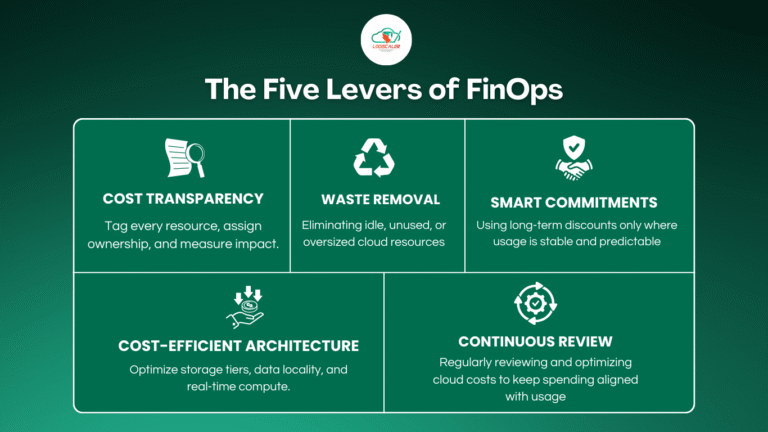
The Five Levers of FinOps That Drive Results
1. Cost Transparency
FinOps begins with clarity. Every resource needs an owner, a tag, and a purpose.
Implementing stringent tagging policies (no-tag, no-deploy) ensures that each instance is linked to a team and environment.
Once data has been standardized with frameworks like FOCUS, define unit metrics such as:
- Cost per 1,000 inferences (AI)
- Cost per active customer (SaaS)
- Cost per transaction (eCommerce)
These metrics translate technical spend into commercial language, allowing finance and leadership to take action.
2. Waste Reduction
Every firm generates waste: idle instances, oversized virtual machines, out-of-date snapshots, and development clusters that run on weekends. Eliminating non-value spend is the fastest way to win in FinOps.
Typical early actions include:
- Introducing automatic sleep schedules for test environments
- Cleaning orphaned storage and unused IPs
- Scaling down oversized nodes and right-sizing workloads
Real-world FinOps programs frequently save 10–30% in the first 60 days by focusing here.
3. Smart Commitments and Discount Optimization
Commitments like AWS Savings Plans can significantly reduce costs; but timing is crucial.
Buying commitments too early simply wastes money; buying them too late results in missed discounts.
The rule is: Clean waste → Baseline usage → Commit.
After you’ve stabilized your consumption, only commit to the portion that is predictable over time. Review these commitments every quarter to ensure they still align with your changing workloads, especially as service mix or AI usage patterns evolve.
4. Cost-Efficient Architecture
Architecture decisions determine cost efficiency long before billing data does.
Small technological decisions; such as data localization, caching, and batching can result in long-term savings, for example:
- Keeping data and compute in the same region to reduce egress
- Applying lifecycle policies so logs and backups move automatically to cheaper storage
- Reserving real-time compute only for latency-critical services
This is where financial impact and engineering discipline meet: Optimizing without sacrificing quality.
5. Continuous FinOps Review
FinOps is only effective if it is done continuously. Successful teams conduct a 30-minute weekly FinOps review with Finance, Engineering, and Product leaders.
Together they:
- Review spend trends and anomalies
- Identify the top three cost drivers
- Decide one actionable step per owner for the next week
With consistency, these incremental improvements accumulate; turning cloud cost management from reactive firefighting into a structured, repeatable operating habit.
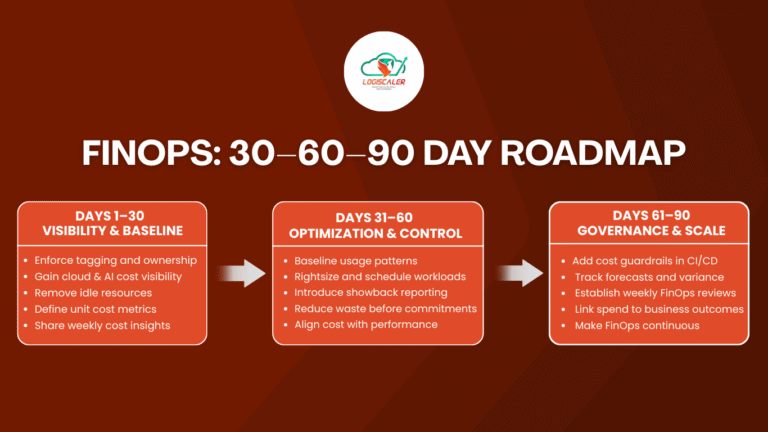
What Does a 30–60–90 Day FinOps Roadmap Look Like?
Days 1–30: Establish Visibility and Ownership
- Enforce tagging and ownership rules across cloud resources
- Deploy visibility tools such as OpenCost
- Remove idle or unused resources
- Define one or two unit cost metrics and share them weekly
Days 31–60: Optimize Usage and Introduce Controls
- Baseline usage and apply selective commitments where appropriate
- Introduce sleep schedules and tiered storage for non-production workloads
- Localize workloads to minimize cross-region data transfer and egress costs
Days 61–90: Embed Governance and Scale FinOps
- Add cost guardrails into CI/CD pipelines
- Publish monthly showback reports for each team
- Present findings, insights, and next actions to leadership
By day 90, FinOps should evolve from a basic maintenance activity into a continuous feedback loop that connects cloud spending directly to business value.
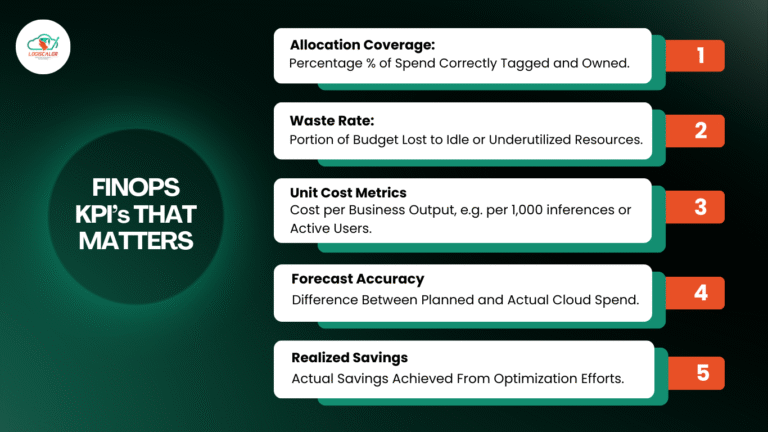
What KPIs Should We Track to Stay Accountable?
1. Allocation Coverage
Percentage of total cloud spend that is correctly tagged and assigned to a clear owner, such as a team, product, or environment. High allocation coverage is essential for accountability and decision-making.
2. Waste Rate
Percentage of cloud spend consumed by idle, unused, or underutilized resources. This metric highlights inefficiencies and identifies quick optimization opportunities.
3. Unit Cost Metrics
Cost of delivering a single unit of business value, such as cost per active customer, cost per transaction, or cost per 1,000 AI inferences. Unit metrics help translate technical spending into business outcomes.
4. Forecast Accuracy
The variance between projected and actual cloud costs over a given period, typically measured monthly. A target range of ±10–15% indicates healthy cost predictability and financial control.
5. Savings Realized vs. Planned
The proportion of planned optimization savings that are actually achieved and reflected in financial results. This KPI ensures FinOps initiatives deliver measurable, real-world impact.
Tracking these metrics weekly keeps every stakeholder aligned and prevents cost creep from returning.
What Are the Most Common FinOps Questions?
Q1. What Is the Ideal First Step in Launching FinOps?
Start with visibility. Enforce tagging, deploy cost monitoring, and define a single unit metric that represents value; such as cost per active user.
Q2. Are Commitments Like Savings Plans Truly Worthwhile?
Yes, but only once waste is eliminated and consumption is predictable. Clean first, then commit!
Q3. How Will We Manage Kubernetes and AI Costs?
Use OpenCost or your provider’s native monitoring to allocate GPU and container charges. Visibility is the foundation for accountability.
Q4. Does FinOps Cause Teams to Slow Down?
No. FinOps integrates financial awareness into existing procedures using automation and data, rather than approvals and bureaucracy.
Q5. How Can Smaller Teams Utilize FinOps Principles?
Begin with a 90-day sprint focused on visibility, rapid wins, and a single basic KPI. Even minor improvements can add up to significant savings over time.
How Does Logiscaler Help Businesses Achieve FinOps Success?
Logiscaler does more than just examine cloud bills; we help you create a culture of cost accountability and long-term efficiency.
Our unique framework, Finonymous, accelerates FinOps adoption by providing your teams with visibility, structure, and actionable insights from the start.
We help organizations:
- Use FinOps frameworks to integrate Finance, Engineering, and Product
- Utilize Finonymous dashboards and analytics to track cloud utilization, AI expenses, and savings opportunities
- Maximize cloud and AI spend with forecasting, right-sizing, and smart commitment planning
- Improve cybersecurity and governance for cloud operations
- Offer real-time cost intelligence to connect technical decisions with financial objectives
Our solution combines financial intelligence with engineering precision, allowing teams to scale confidently, securely, and cost-effectively.
Learn more or get in touch with us at Logiscaler!