Blog
FinOps Maturity: Are You Crawling, Walking, or Running?

Most FinOps conversations start in the wrong place. They start with a tool, a dashboard, or a single headline number — “we cut cloud spend by X% this quarter” — instead of asking a harder question: how mature is the practice behind that number? A team that automated one report isn’t running. A team that’s still chasing surprise bills at month-end hasn’t even started crawling. The distance between those two states is where most cloud budgets quietly leak.
The FinOps Foundation frames cost management as an operating discipline rather than a one-off project, and most practitioners describe its progression informally as Crawl, Walk, Run. It’s a useful shorthand, but only if you’re honest about which stage you’re actually in. This article breaks down what each stage looks like in practice, gives you a way to self-assess without flattering yourself, and lays out the specific moves that take a team from Walk to Run.
Why Maturity Matters More Than Any Single Savings Number
Cloud cost management isn’t a project with an end date — it behaves more like a discipline such as security or reliability engineering. Teams that treat it as a one-time clean-up — renegotiate a few contracts, right-size a batch of instances, declare the job done — tend to drift back to where they started within a couple of billing cycles, because nothing in the underlying process actually changed.
Maturity matters because it predicts whether savings stick. Three things track it closely: how fast anomalies get caught, how much manual effort it takes to answer “why did the bill go up,” and whether finance and engineering are working from the same numbers. None of those show up in a single savings percentage, but they’re the real leading indicators of where a FinOps practice stands.
Low maturity also shows up as organisational friction long before it shows up as a number. When cost ownership is unclear, finance ends up auditing engineering after the fact, engineering treats every finance question as a distraction from real work, and both sides quietly stop trusting the other’s figures. Fixing that dynamic is usually a bigger unlock than any individual cost-cutting exercise, because it’s what lets the two teams plan together instead of negotiating after the spend has already happened.
The Three Stages, at a Glance
Before going stage-by-stage, here’s the short version:
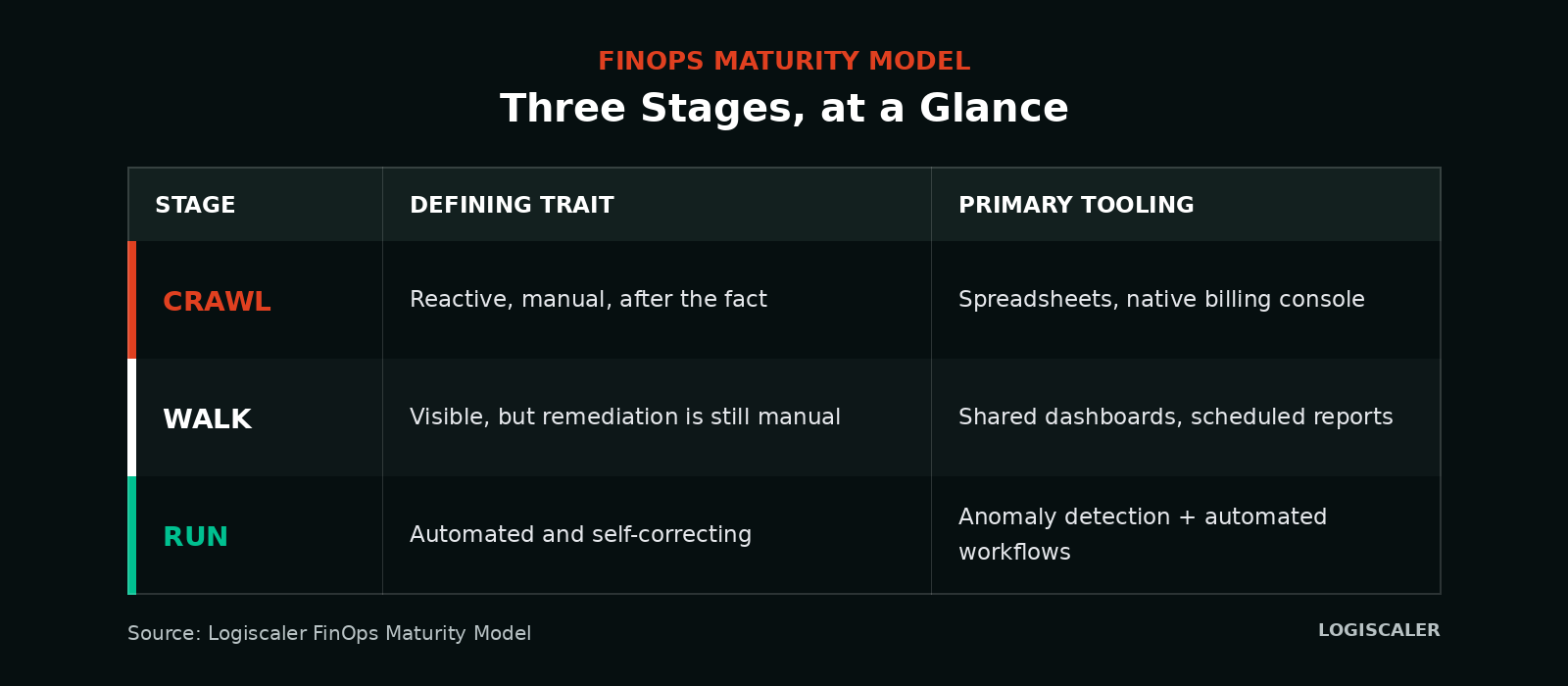
None of these stages is a judgement on effort or talent. A team can be excellent at engineering and still be at Crawl on cost, simply because no one has been given the mandate or the tooling to operate differently. The stages describe process maturity, not team quality.
Crawl: Reactive Cost Management
At Crawl, cost management means looking at the bill after it arrives and reverse-engineering what happened. There’s no real-time signal — just a monthly reckoning.
What Crawl Looks Like in Practice
- Untagged or inconsistently tagged resources make root-cause analysis a guessing game.
- Idle and orphaned resources — unattached volumes, unused load balancers, forgotten dev environments — accumulate because no one owns cleanup.
- Cost anomalies surface only when finance flags a budget variance, often weeks after the spend occurred.
- Engineering and finance reconcile spend manually, frequently in spreadsheets that don’t agree with each other.
- There’s no defined owner for cloud cost. It’s technically everyone’s job, which in practice means it’s no one’s.
The consequence isn’t just wasted spend — it’s wasted trust. When finance and engineering can’t agree on a number, every cost conversation turns into a reconciliation exercise instead of a decision.
Walk: Visibility Without Full Automation
Walk is where most organisations plateau, often for years. There’s genuine progress here — a shared view of spend exists — but action still depends on someone remembering to look at it.
What Changes at Walk
- Tagging governance is documented and partially enforced, though exceptions still slip through.
- A shared dashboard gives finance and engineering a common view of spend by team, service, or environment.
- Anomalies are detected — often through native cloud provider tools — but routed to a person, not a workflow.
- Budget reviews happen on a fixed cadence rather than continuously.
- Right-sizing recommendations exist but require someone to manually action them, so they pile up.
The risk at Walk is mistaking visibility for control. Knowing exactly how much was overspent last week doesn’t recover the spend, and dashboards that no one acts on become expensive wallpaper.
Run: Automation Closes the Loop
At Run, cost governance stops behaving like a monthly ritual and starts behaving like a control system — something that corrects itself between human check-ins, not just during them.
What Run Looks Like
- Anomaly detection triggers automatically, and the resulting alert becomes a ticket routed to the right team without manual triage — the gap Finonymous is built to close between detection and resolution.
- Predictive budgeting flags a likely overrun before it happens, not after the invoice lands.
- Right-sizing and resource cleanup run continuously, rather than during periodic sweeps someone has to schedule.
- Cost attribution is automated and granular enough that finance can allocate spend to teams or products without a manual chargeback process.
- Governance policies — approval thresholds, tagging enforcement, budget guardrails — execute themselves instead of depending on someone remembering to check.
Run isn’t about chasing a lower bill every quarter. It’s about removing the lag between something going wrong and someone — or something — acting on it.
Self-Assessment: Which Stage Are You Actually In?
Be honest here. Most teams describe themselves a stage ahead of where they actually operate, usually because one part of the organisation (often platform engineering) is further along than the rest.
Crawl Indicators
- Could you say, right now, which team owns last month’s cost increase?
- Do you typically find out about a budget overrun from finance, after the invoice has already landed?
- Are untagged resources a known, long-standing, and unresolved problem?
If most of these sound familiar, you’re at Crawl — and that’s a normal, fixable starting point, not a verdict on the team.
Walk Indicators
- Do you have a shared cost dashboard, but still resolve anomalies through Slack threads and individual follow-up?
- Are right-sizing recommendations generated regularly but rarely actioned within the same week?
- Does your tagging policy exist on paper but get enforced inconsistently across teams?
If this is closer to home, you’re at Walk — the stage with the most untapped leverage, because the data already exists.
Run Indicators
- Does an anomaly automatically generate a ticket and route to the owning team without anyone triaging it by hand?
- Can finance attribute cloud spend to a specific product or team without asking engineering for help?
- Do budget guardrails enforce themselves — blocking, escalating, or alerting — without someone checking a dashboard first?
If you answered yes across the board, you’re operating at Run. Most organisations aren’t — and that’s the gap this framework is meant to expose.
How to Move From Walk to Run
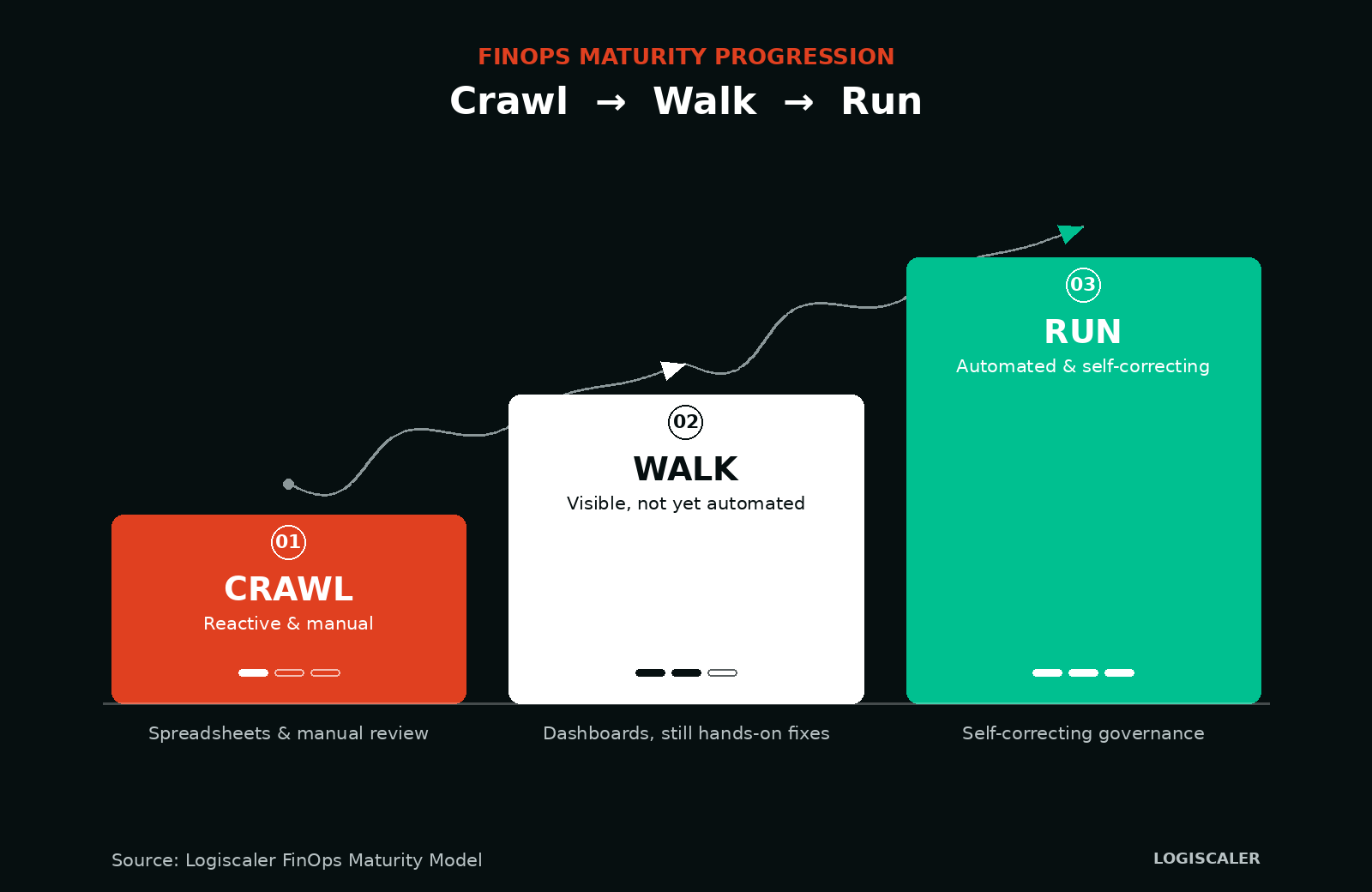
Most teams get stuck at Walk because the move to Run is pictured as a single, large platform investment. In practice, it’s a sequence of smaller, ordered moves:
- Fix tagging governance first. Automation built on inconsistent tags just automates confusion faster.
- Connect anomaly detection to a workflow, not a person. An alert that lands in someone’s inbox is still Walk, no matter how good the detection is.
- Set explicit approval thresholds — by spend amount, resource type, or environment — so routine decisions execute without waiting on a human in the loop.
- Move budget tracking from fixed-cadence reviews to continuous, predictive monitoring that flags risk before the invoice, not after.
- Automate cost attribution so finance isn’t dependent on engineering’s manual chargeback work every billing cycle.
- Codify governance policies wherever possible, so they apply consistently across teams, accounts, and clouds instead of varying by who’s on call.
Where Finonymous Fits
Logiscaler built Finonymous around this exact gap. Most FinOps tools stop at Walk: they give you a dashboard and leave the resolution work to whoever happens to be watching it. Finonymous closes the loop — anomaly detection feeds directly into automated ticket routing, governance policies execute as code, and cost attribution updates continuously instead of waiting on a manual chargeback cycle. The goal isn’t a prettier dashboard; it’s fewer decisions that depend on a human remembering to make them.
Book a free FinOps maturity review and our team will map your environment to one of these three stages directly, with a concrete next step you can act on this quarter — not a generic audit deck.
Cloud cost problems rarely come from a lack of effort. They come from effort that has to be repeated every single month because nothing in the underlying process moved from manual to automated. Crawl and Walk both work, in the sense that the bills get paid and the business keeps running. Run is the only stage where the system gets better on its own.